
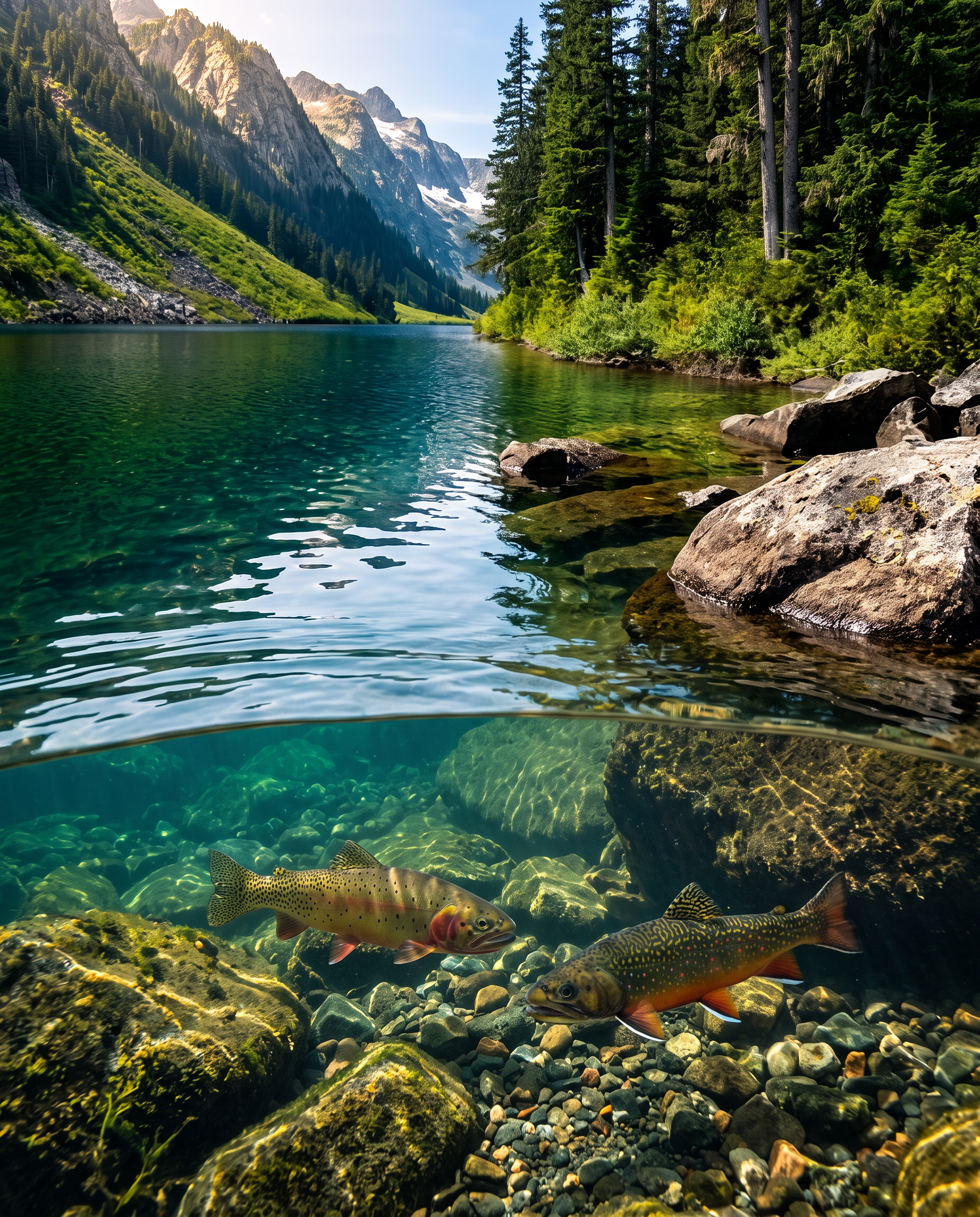
Real 3D trout, swum along Catmull-Rom splines.
Each fish is a lathed trout body skinned with procedurally painted brook and cutthroat markings, then deformed by a travelling wave in the vertex shader so the S-curve comes from the geometry itself. Their paths are closed splines through the tank — move your cursor to shift the camera.
Colorado trout, engineered on purpose.
Move your cursor — the trout scatter. Click anywhere — food drops and they hunt. Watch the light: dawn and dusk they rise and feed hard; midday they hold deep in shade; at night they rest low and slow.
Cutthroat · Brook · Rainbow — click water to feed
Ten features of a premium trout environment.
Every one of these is a civil-engineering deliverable. Ansom Outdoor designs the reach, the structure list, the specs, and the monitoring plan — so the tank works after we leave.
- 01Cold-water thermal refuge
Shaded plunge pools + hyporheic exchange to hold 55–62°F even in August. The single biggest lever for wild trout survival.
- 02Riffle–run–pool sequencing
Engineered longitudinal profile with 60% riffle for oxygen, 25% run for travel, 15% pool for holding — mimics reference reaches.
- 03Boulder cluster & cover complexity
Placed hydraulic structures (J-hooks, cross vanes, boulder clusters) create eddies, focus flow, and give big fish shoulder-height cover.
- 04Spawning gravel beds
Cleaned 1/2"–1.5" round gravel, 8" deep, in oxygenated tailouts. Sized for cutthroat and brookie redds, sluice-flushed each spring.
- 05Riparian buffer + willow reintroduction
30-ft native willow/alder buffer for shade, bank strength, terrestrial insect drop, and a beaver-tolerant edge.
- 06Sediment & nutrient filtration inlet
Forebay + wetland cell strips road/pasture runoff before it reaches the reach. Clarity is habitat.
- 07Groundwater-fed side channel
A spring-fed refugium loop stays ice-free in winter and cool in summer — a genetic ark when the main stem stresses.
- 08Beaver dam analog (BDA) network
Post-and-weave low structures raise water tables, expand wetted area, and let real beavers finish the job when they arrive.
- 09Fish-passable diversion & screening
Roughened-rock ramps replace concrete drops; wedge-wire screens on diversions keep juveniles out of ditches.
- 10Monitoring & adaptive management
Temperature loggers, annual redd counts, drone photogrammetry — the design keeps learning after we hand over the keys.